


INTERVIEW — BENJAMIN PLU
Voyager à travers le monde grâce au football américain

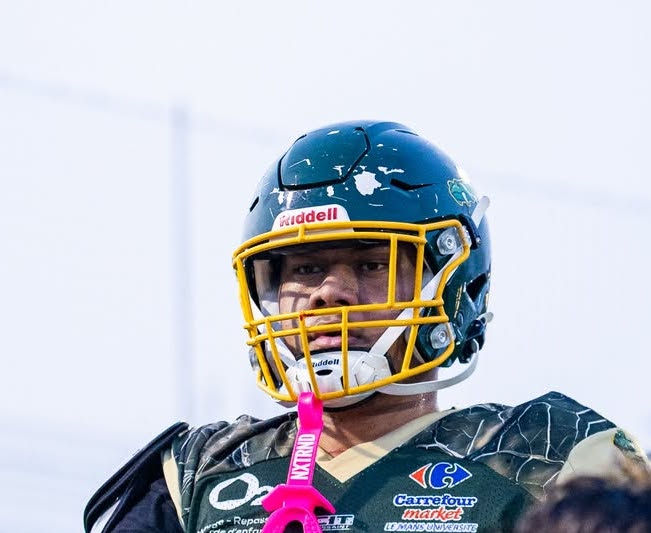
Du Mans à Montréal, de Vancouver à la Finlande, de Barcelone à la Hongrie, Benjamin Plu a construit un parcours international à travers le football américain. Passé par McGill University, la CFL et plusieurs ligues européennes, il revient sur son évolution, les défis du professionnalisme et les leçons d’une carrière marquée par l’adaptation.
Les débuts
NSL : Qu’est-ce qui vous a attiré vers le football américain et comment votre parcours a-t-il commencé ?
B : J’ai découvert le football américain grâce à un ami au lycée. Il jouait à Le Mans, ma ville natale. On lançait le ballon pendant les pauses et il m’a proposé de venir essayer un entraînement. C’est comme ça que tout a commencé.
L’expérience McGill
NSL : Que vous a apporté votre passage à McGill University ?
B : À McGill, j’ai dû m’adapter à un système différent, celui d’étudiant-athlète, que nous n’avons pas vraiment en France. On représente son université à travers son sport. Cela m’a donné une nouvelle perspective sur mon engagement et sur la discipline.
On peut dire que nos entraîneurs nous ont aidés à grandir et à nous organiser car nos journées étaient chargées. Entre les cours et les entraînements, parfois deux fois par jour et très tôt le matin, il faut aussi savoir préserver sa santé.
Nous développons une discipline forte. Aujourd’hui, je réalise que c’est un atout lorsque j’ai un objectif précis à accomplir.
Le passage au niveau professionnel
NSL : Quels ont été les principaux défis lors du passage du niveau universitaire au monde professionnel, notamment vers la CFL ?
B : L’un des plus grands défis est de prouver que l’on a sa place et que son développement est suffisamment intéressant pour rester dans l’équipe.
On entre dans un autre monde. C’est une ligue professionnelle, un business avec des attentes à satisfaire.
Un autre défi important est que la ligue regroupe les meilleurs joueurs du pays. On atteint un niveau où chaque action compte. Si vous ne donnez pas 100 % à chaque jeu ou si vous ne vous dépassez pas à chaque instant, le match peut basculer.
Jouer en Europe
NSL : Comment décririez-vous la vie d’un joueur professionnel en Europe par rapport à l’Amérique du Nord ?
B : En Europe, il existe des différences par rapport à l’Amérique du Nord, notamment en ce qui concerne les infrastructures. La situation est assez hétérogène. Certaines équipes disposent d’installations complètes et d’un staff important pour encadrer l’équipe, d’autres moins.
Malgré cela, nous nous entraînons tous durant la semaine pour préparer les matchs du week-end. Certains joueurs locaux conservent leur emploi pendant la saison car les salaires sont plus faibles. Selon le pays d’origine ou le pays dans lequel on évolue, le salaire n’est pas toujours une priorité.
Cependant, le marché européen attire de plus en plus l’attention et le niveau continue de se développer. Il y a des athlètes incroyables et un encadrement de plus en plus qualifié.
Parcours international
NSL : Vous avez joué en France, au Canada, en Finlande, en Espagne et en Hongrie. Que retenez-vous de ces expériences ?
B : En France, Le Mans est l’endroit où j’ai grandi et découvert le football américain. Puis Amiens avec l’équipe de France, où j’ai continué à progresser. Ensuite Thonon-les-Bains, chez les Black Panthers, avec lesquels nous avons été champions de France. Une année charnière pour moi puisque j’ai également été drafté cette année-là par les BC Lions.
Avant les Black Panthers, je suis parti à Montréal à McGill University, une ville accueillante avec une forte culture européenne. C’est une ville très tournée vers la culture et les arts, que j’ai eu du mal à quitter. On s’y attache ; j’y ai disputé mon premier match dans un grand stade.
Puis il y a eu Vancouver, une immense ville entourée d’une nature impressionnante. Je regrette de ne pas avoir davantage découvert la ville car j’étais très occupé par le football.
Pendant le Covid, j’ai joué en Finlande, à Seinäjoki, ce qui m’a permis de relancer ma carrière après avoir été coupé en CFL. Ce fut l’une de mes meilleures expériences en termes de qualité de vie. Cela m’a permis de rebondir en Europe, notamment en ELF.
J’ai ensuite joué pour les Barcelona Dragons. Les Espagnols sont très détendus. Cette année-là, nous avions une très grosse équipe et un staff très compétent ; d’un point de vue sportif, cela reste l’un de mes meilleurs souvenirs.
Puis il y a eu Fehérvár en Hongrie. Une saison avec des hauts et des bas, mais des joueurs qui n’abandonnaient pas et une culture qui m’a surpris. Les gens y sont chaleureux et accueillants, et l’architecture est remarquable.
S’adapter à l’international
NSL : Comment gérez-vous les différences culturelles et linguistiques ?
B : L’anglais reste la langue la plus utilisée. Bien sûr, nous essayons d’apprendre quelques mots de la langue du pays. Il est aussi important de s’intégrer, de découvrir la culture et de comprendre ce qui peut être mal perçu.
Quand on représente une équipe, il faut être irréprochable. Ce qui est remarquable, c’est que lorsque chacun partage un peu de sa culture, cela crée des échanges enrichissants et permet d’apprendre sur les autres et sur le monde. Cela remet parfois en question certains préjugés.
Préparation et équilibre
NSL : Quelle est votre méthode pour maintenir votre condition physique et votre santé en voyage et en compétition ?
B : Les entraînements sont généralement planifiés en fonction de la semaine et des déplacements à venir. J’essaie donc de donner le maximum tout en prenant soin de mon corps.
Pendant les déplacements, j’essaie de ne pas penser au match avant d’arriver au stade. Cela m’aide à garder l’esprit clair.
NSL : Quel conseil donneriez-vous aux personnes qui voyagent régulièrement et souhaitent rester actives et en bonne santé ?
B : Le mouvement reste l’un des meilleurs moyens de rester en bonne santé et de stimuler les hormones du bien-être. Il faut profiter de son environnement : marcher, utiliser les salles de sport si possible, bien s’hydrater et surtout profiter du voyage.
Être en bonne santé implique autant le corps que l’esprit.
Regard sur le football européen
NSL : Comment voyez-vous l’évolution du football américain en Europe ces dernières années ?
B : Il y a eu une évolution significative. De nombreux joueurs ont été repérés pour évoluer dans des ligues plus développées et plusieurs entraîneurs ayant une expérience NFL sont arrivés en Europe.
Les infrastructures deviennent plus professionnelles pour le bien-être des joueurs. La nouvelle ligue professionnelle est très médiatisée. Il y a des progrès, mais un écart important subsiste encore et ne permet pas à tous les joueurs de se consacrer exclusivement au football.
Popularité et impact culturel
NSL : Que pensez-vous de la popularité croissante du football américain en dehors de l’Amérique du Nord ?
B : De plus en plus de personnes s’y intéressent. C’est un marché en développement, mais il faudra encore quelques années pour qu’il devienne pleinement professionnel. Il devrait y avoir davantage de structure autour des joueurs afin de mieux les protéger.
Cette pratique gagne néanmoins en popularité, comme on peut le constater chaque année avec le Super Bowl.
NSL : Comment percevez-vous l’impact culturel et social du football américain dans les pays européens où vous avez joué ?
B : La plupart du temps, ce n’est pas le sport prioritaire. Mais c’est un jeu qui demande un fort engagement et qui devient passionnant. Il conserve souvent une touche de culture américaine, notamment dans la terminologie. Il continue de croître et rassemble de plus en plus de personnes.
Exigence du poste
NSL : En tant que receveur, quelles sont les qualités essentielles que vous avez dû développer ?
B : En tant que receveur, au-delà de la vitesse et de l’agilité, il faut savoir s’adapter à la défense. Il faut jouer action après action et rester concentré à 100 %. Même avec la fatigue, il faut être capable d’exécuter chaque jeu.
Esprit d’équipe
NSL : Comment avez-vous favorisé la cohésion malgré les différences culturelles et linguistiques ?
B : Nous nous rassemblons tous autour du même sport. Nous travaillons dur ensemble, ce qui crée des liens. Ces différences nous rapprochent car nous avons tous le même objectif : gagner le plus de matchs possible et être champions.
J’ai apporté mon expérience, partagé des conseils et aidé les joueurs à progresser, tout en apprenant moi-même d’eux. L’avantage du football, c’est que le langage est presque universel.
Conseils aux jeunes joueurs
NSL : Quel conseil donneriez-vous aux jeunes joueurs souhaitant évoluer à l’international ?
B : Je leur dirais de suivre leurs rêves. Aucun objectif n’est inatteignable. Il faut donner le maximum, mais aussi s’investir dans d’autres domaines, notamment les études. Vérifiez l’équivalence de vos diplômes et n’oubliez pas vos autres passions.
Leçons de parcours
NSL : Quelle est la principale leçon que vous retenez de votre parcours ?
B : On ne réussit pas tout. Il y a des échecs même lorsque l’on s’investit pleinement. Mais on ne peut pas avoir de regrets lorsque l’on sait que l’on a tout donné.
Aujourd’hui
NSL : Où êtes-vous basé actuellement et quels sont vos projets ?
B : Je suis désormais installé à Genève avec ma fiancée. Entre les saisons, j’ai obtenu mon diplôme d’entraîneur suisse car j’aime transmettre mon expérience et mes conseils. J’espère continuer cette activité le plus longtemps possible.
INTERVIEW - BENJAMIN PLU
Traveling the World Playing Football

From Le Mans to Montreal, from Vancouver to Finland, from Barcelona to Hungary, Benjamin Plu has built an international journey through American football. Having played at McGill University, in the CFL and in several European leagues, he looks back on his development, the challenges of professionalism and the lessons from a career marked by adaptation.
NSL: Hello, Ben; thank you for taking the time to answer the questionnaire. What initially drew you to American football, and how did you start your sporting journey?
B: Hello, thank you. It's a pleasure for me to share my experience with your magazine. I discovered American football through a friend when I was in high school. He was on the team in my hometown of Le Mans, we used to throw balls around during breaks. He invited me to come try out for a practice.
NSL: Can you tell us about your experience at McGill University and how it contributed to shaping your sports career?
B: When I found myself at McGill University, I had to adapt to a different system we don't have back home—the system of being a student-athlete. We represent our university through our sport. This taught me to have a different perspective on my relationship with school and my commitment.
We can say that our coaches helped us grow and organize ourselves because we had busy days. With classes and training, sometimes twice a day, sometimes very early in the morning, you also need to be able to maintain your health.
We develop a strong discipline. Today, I realize that it's a plus when I have something specific to accomplish.
NSL: What challenges did you face in transitioning from college football to the professional level, especially moving from the Canadian university league to the CFL?
B: One of the biggest challenges is proving that you belong and that your development will be interesting to stay on the team.
You enter into another world. It's a professional league, a business with expectations you must meet.
Another significant challenge is that the league brings together the best players in the country. You reach a level where every play you don't give 100% or every time you don't push yourself can turn the game around.
NSL: What is the life of a professional American football player like outside the United States and Canada? What are the main differences compared to playing in North America?
B: Indeed, in Europe, there are some differences compared to North America, especially regarding infrastructure. It's pretty heterogeneous. Some teams have complete training facilities, with many staff to support the team, some teams have less. Despite this, we all train during the week to prepare for the weekend. Some local players keep their jobs during the season because salaries are much lower. Sometimes, depending on your home country or the country where you live, the salary you receive is not a priority.
In Europe, a growing market is starting to attract attention, with a significant level that continues to develop. Incredible athletes play this sport, and there is increasingly high-quality coaching.
NSL: You have played for several clubs and cities in Europe and Canada. Could you please mention which and what your most memorable experiences were in terms of culture, travel, and adapting to new environments?
B: In France, Le Mans is where I grew up and discovered American football. Then Amiens with the French national team where I continued to develop, and finally Thonon-les-Bains, the Black Panthers, with whom we were French champions. A pivotal year for me because I was also drafted that year for the BC Lions. Just before the Black Panthers, I went to Montreal at McGill University, a welcoming city with a strong European culture.
A city very focused on culture and arts that I found hard to leave. You get attached to it; I played my first game there in a big stadium.
Then, there was Vancouver, a huge city surrounded by incredible nature. I regret not discovering the city more because I was very busy with football.
During Covid, I played in Finland, which relaunched me after being cut from the CFL. I played in Seinäjoki. It was one of my best experiences in terms of quality of life. This allowed me to bounce back into the professional league in Europe, the ELF.
I played for the Barcelona Dragons, a rather day-to-day lifestyle. Spaniards are very chill. That year, we had a huge team and a very competent staff; from a sports perspective, it is one of my best memories.
Then there was Fehérvár in Hungary. It was a season with ups and downs, but players who didn't give up and a culture that surprised me. They are amicable and welcoming people and have incredible architecture.
NSL: How do you handle linguistic and cultural challenges when playing in foreign countries?
B: English remains the most used language. Of course, we try to learn a few words of the country's language. It's also important to integrate, discover the culture, and know what is frowned upon. When representing a team, you have to be somewhat impeccable. What's remarkable is that when everyone shares a bit of their culture, we have interesting exchanges and learn a lot about others and the world, and it often challenges our previous prejudices.
NSL: What is your ritual or method for maintaining your physical condition and health while traveling and competing at a high level?
B: Often, training sessions are planned according to the week ahead and the travel we will have. So, I try to give my all while caring for my body.
And during trips, I try not to think about the game until I arrive at the stadium, it helps clear my mind.
NSL: What advice would you give to people who travel regularly and want to stay active and healthy during their travels?
B: Movement remains one of the best ways to stay healthy and stimulate well-being hormones. You have to take advantage of your surroundings. Go for walks, use gyms if you can access them, maximize your hydration, and above all, enjoy your trip and find a moment for yourself. Clear your mind. Being healthy involves both the body and the mind.
NSL: How do you view the evolution of American football in Europe in recent years? Have you observed significant progress or persistent obstacles?
B: There's been significant evolution. Many players have been spotted to play in more developed leagues and many coaches with NFL experience have come here.
Infrastructures are becoming more professional for the well-being of players. The new pro league is very well publicized. There is progress, but a significant gap still doesn't allow all players to focus solely on their football practice.
NSL: What is your opinion on the increasing popularity of American football outside of North America? How can this contribute to the expansion and diversification of the sport?
B: More and more people are becoming interested in it. It's a market that is being exploited, but it will take a few more years for it to become truly professional. There should be more structure around the players to better protect them, as ultimately in companies.
But this practice is becoming popular; as we can see with the Super Bowl every year, it's increasingly appreciated.
NSL: What are your impressions of American football's cultural and social impact in the European countries where you have played?
B: Most of the time, it's not the priority sport. But it's a game that requires great involvement and becomes exciting. It often has a touch of American culture, especially in terms of terminology. It's growing and starting to bring more people together.
NSL: As a receiver, what are the most important skills and mental qualities you have had to develop over the years to excel in your position?
B: As a receiver, besides being fast and agile, you also need to adapt to the defense. You have to be able to play one game at a time and be 100% focused on it because even with fatigue, you have to be able to execute any play.
NSL: How did you approach team competition and foster a strong team spirit despite cultural and linguistic differences?
B: Firstly, we all come together around the same sport; we train hard together, which creates bonds. These differences also help us come closer, as in the end, we all have the same goal: to win as many matches as possible and to be champions.
I brought my experience, shared advice, and helped players evolve while learning from them to progress myself. The advantage of football is that the language is almost the same in all countries.
NSL: What advice would you give young athletes aspiring to follow in your footsteps and play professional American football internationally?
B: I would advise them to follow their dreams, of course. There are no goals that cannot be achieved. You must give it your all, but you must also be involved in other things. Don't do it just for the sake of it, especially in school. Please make sure to verify the equivalence of your diplomas and qualifications. Additionally, do not forget to pursue your other passions and interests.
NSL: Looking back on your journey so far, what lessons or key moments have you learned that have shaped your approach to sports and life?
B: One of the main lessons is that you can only succeed at some things. There are failures even when you're highly involved. But you can't have regrets when you make sure everything goes well.
NSL: You are what one could consider a sports traveler. Do you have any cities or places that you would recommend our readers to visit?
B: I would recommend visiting Finland. It is a beautiful country filled with incredible nature; people are open and welcoming. Helsinki is a beautiful capital, but every city throughout Finland has its charms.
NSL: Finally, can you tell us where you are currently based, what your profession and personal projects are, and what we can wish you for the future?
B: I am now settled with my fiancée in Geneva. Between my seasons, I obtained my Swiss coaching diploma because I love sharing my experience and advice in the gym, and I hope to practice this activity for as long as possible.
NSL: Lastly, what message would you like to convey to our readers and to those who have followed and continue to follow your journey with interest?
B: I will never thank enough all those who have supported me. It's incredible to receive messages of support or people asking for advice. I'm very open, and it has always been a pleasure for me to talk to those I've met on the field. It's always nice to exchange with people. Thank you all!


Comments