


THE NIL ERA: HOW STARS ARE RESHAPING COLLEGE FOOTBALL
Updated: 2 hours ago

A Historic Shift
For over a century, College Football thrived on tradition: legendary rivalries, iconic coaches, and roaring stadiums. But in just four years, a seismic change has shaken the sport’s foundations.
The legalization of NIL (Name, Image, Likeness) and the full opening of the transfer portal have propelled college athletics into a new dimension. Athletes no longer just play. They monetize their image, choose their destination, and influence those around them.
Power has shifted from the coaches to the locker room. Today’s superstars are not only players, they are recruiters, cultural leaders, and economic symbols. Welcome to the era of the program-builders.
Quarterbacks: From Leaders to Architects
No position embodies this transformation better than quarterback.
At Illinois, Luke Altmyer has already gotten involved in recruiting, voicing his opinion on which profiles should be targeted. At UCLA, the transfer of Nico Iamaleava (ex-Tennessee) triggered a true domino effect: the prodigy’s arrival forced Joey Aguilar (Appalachian State, briefly committed to UCLA) back into the portal… only for him to land at Tennessee, completing a game of musical chairs.
These cases demonstrate how a single star can reshape a roster and influence the entire transfer market. As CBS Sports revealed, some quarterbacks are no longer afraid to tell the staff directly: “this guy isn’t good enough” or “this is the profile we need.”
The quarterback is no longer just the on-field strategist. He has become an architect of the roster, a magnet for transfers, and a locker room strategist.
Texas Tech: A Laboratory of the Future
If one program best symbolizes this new era, it is Texas Tech.
In just three years, the Red Raiders have become a central player in the NIL revolution. Backed by a collective of donors and local businesses, they have raised over $63 million since 2022, with $55 million already committed in active contracts.
This financial power translated into an impressive 2025 transfer class: 21 arrivals, half of whom are projected starters. But more than the numbers, one name crystallizes this revolution: Felix Ojo.
The Felix Ojo Case: The Purchased Star
A five-star offensive tackle ranked among ESPN’s top 20 prospects in the 2026 class, Ojo chose Texas Tech over traditional powerhouses. The reason? A record deal: $5.1 million guaranteed over three years, structured as a revenue-sharing agreement.
It is one of the largest deals ever signed by a high school recruit since direct payments to student-athletes became legal. For Texas Tech, it is a marketing coup, a sporting statement, and a symbol: proof that with the right resources, even a program without a decorated history can compete with SEC or Big Ten giants.
Recruiting Felix Ojo is more than just a win on the field: it is a manifesto. Texas Tech is declaring that in modern College Football, it is possible to “buy glory” — or at least to make a serious attempt at it.
Michigan: Balancing Money and Culture
On the opposite end of the spectrum, some programs are embracing a more balanced approach. Michigan, the 2024 national champion, managed to integrate NIL without abandoning its values.
Minnesota head coach P.J. Fleck did not hesitate to praise the Wolverines’ method:
“They built a transformational culture, not a transactional one.”
In other words, Michigan uses NIL to retain its stars and attract new ones, but its foundation remains a strong collective culture. That cohesion, more than financial muscle, propelled the Wolverines to the 2024 title.
This contrast highlights College Football’s current dilemma: should programs invest heavily and immediately — risking locker room chemistry — or prioritize slower, more sustainable growth?
An Unstable, Frustrating System
Beneath the excitement, the reality is messier.
As the New York Post reported, many coaches and agents describe a frantic race for money destabilizing young athletes. At just 18 or 19, some are signing six- or seven-figure contracts without any real preparation for pressure or financial responsibility.
Transfers are multiplying — sometimes two or three times in as many years. The result: disrupted rosters, fragile projects, and fans disillusioned as their favorite stars hop from school to school.
A Two-Speed NCAA
The most obvious danger is a two-speed NCAA.
Programs with deep pockets such as Texas, Alabama, Ohio State, USC...already hoard some of the best talent. Meanwhile, respected institutions like Cal or Stanford, once valued for their academic and athletic stability, are turning into temporary incubators: their best players shine for a season before bolting for better-funded, higher-profile destinations.
It is a form of invisible realignment. Officially, conferences shift and reorganize. In practice, it is the flows of players and money that redraw the College Football map.
When College Mimics the Pros
College Football has never looked so much like the pros:
Players influence recruiting like LeBron James does in the NBA.
Coaches act as general managers, juggling locker room dynamics and contracts.
Sponsors have a direct hand in shaping athletic strategy.
For fans, it is fascinating — a mix of tradition and business. For purists, it is a drift that threatens the very essence of the college game.
The Biggest NIL Deals in 2025
NIL valuations are soaring. According to On3, here are the year’s top figures:
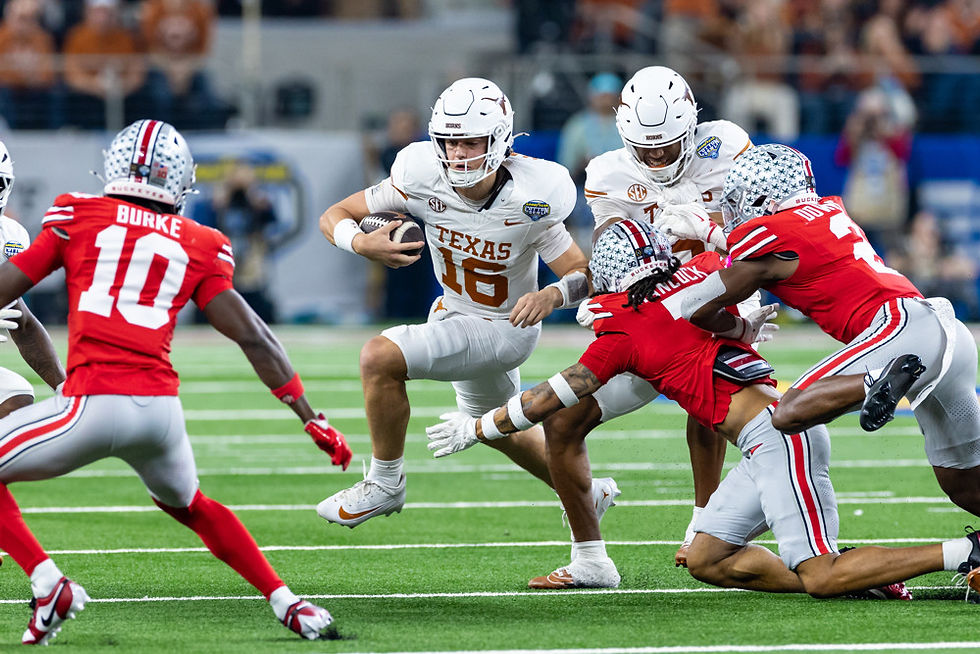
Arch Manning (Texas, QB): $6.8M
Carson Beck (Miami, QB): $4.3M
Jeremiah Smith (Ohio State, WR): $4.2M
Garrett Nussmeier (LSU, QB): $3.8M
DJ Lagway (Florida, QB): $3.7M
These numbers confirm that NIL has become a central pillar, as strategic as recruiting or game planning.
Francophone Fans: Privileged Spectators
For French-speaking fans, whether in Canada, Europe, or beyond, this shift makes College Football more accessible and compelling.
The alignment with pro models (NIL, transfers, star influence) makes it easier to follow, while the individual storylines are irresistible. Following Nico Iamaleava, Arch Manning, or Felix Ojo means tracking 19- or 20-year-olds already surrounded by near-Hollywood storytelling.
An Uncertain but Thrilling Future
In the short term, the formula works: spectacle is guaranteed, the 12-team playoff promises fireworks, and networks like ESPN and Hulu are rolling out documentaries to capture the hype.
But long-term questions remain:
How to protect the academic balance of student-athletes?
How to preserve the flavor of historic rivalries and traditions?
How to keep smaller programs competitive?
And above all, can the NCAA avoid becoming an NFL-lite, where only a handful of giants hoard money, talent, and media attention?
Conclusion: A Fragile Balance
College Football in 2025 stands at a crossroads. Texas Tech and its record deal for Felix Ojo embody the power of money and the possibility of disrupting the hierarchy. Michigan shows that a culture-driven model can still thrive. Between the two, dozens of programs search for their path.
One thing is certain: the NIL era and the transfer portal have changed the sport forever. College Football has become a stage where tradition and business collide. And for fans, one thing is undeniable — it has never been more unpredictable, and therefore never more captivating.


Comments