


Le college football à Wembley : 46 523 spectateurs et un marché encore à construire

Londres. Kansas et Arizona State sont entrés dans l'histoire samedi en disputant le premier match de football universitaire entre deux programmes FBS jamais organisé au Royaume-Uni, dans l'enceinte de Wembley. Les Sun Devils se sont imposés 24 à 17, mais c'est surtout le chiffre d'affluence qui a fait parler.
46 523 spectateurs, loin de l'objectif
L'affluence annoncée pour cette première édition de l'Union Jack Classic a été de 46 523 spectateurs, un chiffre inférieur aux quelque 60 000 fans espérés par les organisateurs.
L'écart avec l'objectif s'est vu à l'œil nu. Tout l'étage supérieur de Wembley est resté vide, illustrant la difficulté à remplir la plus grande enceinte du Royaume-Uni.
Certains supporters britanniques avaient d'ailleurs été prévenus par e-mail deux semaines avant la rencontre qu'ils seraient surclassés vers les tribunes basses. « Ils galèrent à vendre en haut, alors ils ont fait descendre les gens », résumait Paul Goldsack, venu avec son fils adolescent. Le stade affiche une capacité de 86 000 places en configuration football américain : le taux de remplissage plafonne donc autour de 54 %.
15 000 supporters venus des États-Unis
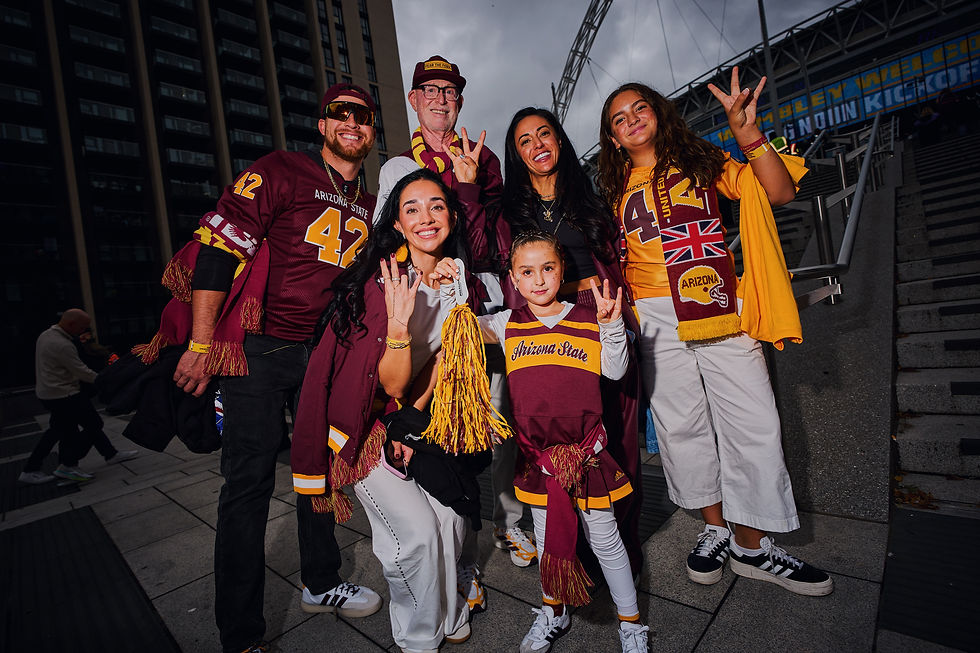
Environ 15 000 supporters ont fait le déplacement depuis les États-Unis, selon la BBC : 9 000 derrière Arizona State et 6 000 pour Kansas. Ils représentaient ainsi près d'un tiers des 46 523 spectateurs présents à Wembley.
Le contingent américain a donc répondu présent. Arizona State avait d'ailleurs écoulé son quota initial de 6 000 billets avant d'obtenir une rallonge portant le total à 9 000. Avec un objectif initial fixé autour de 60 000 spectateurs, l'écart avec l'affluence finale semble donc davantage provenir des ventes réalisées au Royaume-Uni que des supporters ayant traversé l'Atlantique.
Le match : Arizona State gagne sans le ballon
Statistiquement, ce sont les Jayhawks qui ont dominé : 414 yards gagnés contre 228, 22 premiers essais contre 13, et une moyenne de 5,6 yards par action contre 3,5. Mais Kansas a perdu trois ballons (deux fumbles, une interception) quand Arizona State n'en a concédé aucun.

Les unités spéciales ont joué un rôle décisif. Les deux touchdowns les plus spectaculaires sont venus de retours : un punt return de 72 yards de Tate Nagy pour Kansas au 2e quart-temps, puis un retour de kickoff de 100 yards de Jaren Hamilton dès la reprise, qui a fait basculer la rencontre. Le quarterback des Sun Devils C. Boley a ajouté une passe de touchdown de 25 yards pour R. Harris et un touchdown au sol d'un yard. Kansas est revenu à 24 à 17 grâce à une passe de 38 yards d'Isaiah Marshall vers Nagy et un field goal de 46 yards, sans parvenir à égaliser.
Deux rendez-vous européens en une saison : l'aubaine des fans locaux
C'est le point positif, et il n'est pas mince. Les amateurs européens de football universitaire ont eu droit cette saison à deux rendez-vous sur leur continent. Le 29 août à Dublin d'abord, où TCU affrontait North Carolina à l'Aviva Stadium pour l'ouverture de la saison, avec en prime le lancement de la deuxième saison de Bill Belichick sur un banc universitaire.
Puis Londres, trois semaines plus tard. Pour un fan basé à Paris, Berlin ou Madrid, c'est un vol d'une heure et un week-end au lieu d'un billet transatlantique, d'une autorisation ESTA et d'une semaine de congés : l'accès à une expérience jusqu'ici réservée à ceux qui pouvaient se payer le voyage aux États-Unis.
Ce public existe, d'ailleurs : des supporters de pas moins de 35 pays ont acheté des billets pour le match de samedi. Et Dublin prouve que le modèle peut s'installer. Le match 2025 entre Kansas State et Iowa State s'était joué à guichets fermés, pour un impact économique estimé à 132 millions d'euros, et la série vient d'être prolongée jusqu'en 2028, avec Pittsburgh contre Wisconsin déjà programmé en 2027.

Le vrai débat : exportable, vraiment ?
Reste la question de fond, celle que ces 46 523 spectateurs posent en creux.
La NFL s'exporte depuis bientôt vingt ans à Londres avec une armada de stars mondialement identifiables et un produit standardisé. Le football universitaire, lui, vend exactement l'inverse. Son carburant, ce sont des rivalités centenaires, des campus, des villes qui vivent au rythme d'une équipe, bref, tout ce qui par définition ne rentre pas dans une soute d'avion. Les fanfares de Kansas et d'Arizona State ont fait le déplacement et ont tenu l'ambiance tout l'après-midi, mais un samedi à Wembley, sans tailgate dans les parkings de Lawrence ni étudiants massés depuis l'aube, ne peut reproduire l'expérience d'un samedi d'automne dans le Midwest.
Et le coût est réel. Le match comptait comme une réception pour Kansas, qui a donc sacrifié une date à domicile, compensée par 2,7 millions de dollars et des frais de déplacement intégralement pris en charge. Les Jayhawks ont choisi 2026 précisément parce que la capacité de leur David Booth Kansas Memorial Stadium est réduite par des travaux, ce qui rendait le sacrifice plus acceptable cette année-là. La vraie question est de savoir si un programme au stade plein acceptera un jour le même marché, et si le public britannique, qui connaît les Chiefs ou les Eagles mais pas les Sun Devils, viendra sans la promesse d'une superstar sur le terrain.
Une stratégie de long terme
Le projet, lui, s'inscrit dans la durée. Brett Yormark, commissaire de la Big 12, veut poursuivre l'expérience et les organisateurs de l'Union Jack Classic ont signé un accord pluriannuel avec Wembley. D'autres programmes de la conférence seraient déjà intéressés, et une annonce concernant l'édition 2027 est attendue dans les prochains mois.
Wembley n'a donc pas démontré que le college football pouvait reproduire son modèle américain en Europe. Il a en revanche montré qu'un public existe. Reste désormais à savoir s'il est suffisamment nombreux pour faire de Londres autre chose qu'une destination exceptionnelle.
College Football at Wembley: 46,523 Fans and a Market Still to Be Built

London. Kansas and Arizona State made history on Saturday, playing the first college football game between two FBS programmes ever staged in the United Kingdom, at Wembley. The Sun Devils won 24-17, but it was the attendance figure that got people talking.
46,523 fans, short of the target
The announced attendance for this first edition of the Union Jack Classic was 46,523, below the roughly 60,000 organisers had hoped for.
The shortfall was plain to see. The entire upper tier of Wembley was left empty, a reflection of how hard the UK's largest venue is to fill. Some British supporters had in fact been told by email two weeks before the game that they would be moved down into the lower bowl. "They're struggling to sell up top, so they've moved people down," said Paul Goldsack, who came with his teenage son. With a capacity of 86,000 in American football configuration, the stadium was therefore only about 54 per cent full.
15,000 supporters from the United States
Around 15,000 supporters travelled from the United States, according to the BBC: 9,000 behind Arizona State and 6,000 for Kansas. That amounted to close to a third of the 46,523 spectators at Wembley.
The American contingent, in other words, turned up. Arizona State had sold through its initial 6,000-ticket allocation before securing an increase that took the total to 9,000. Against an original target of around 60,000, the gap with the final attendance therefore appears to stem more from sales in the United Kingdom than from the fans who crossed the Atlantic.
The game: Arizona State win without the ball
Statistically, it was the Jayhawks who dominated: 414 total yards to 228, 22 first downs to 13, and an average of 5.6 yards per play against 3.5. But Kansas gave the ball away three times (two fumbles, one interception) while Arizona State committed no turnovers at all.

Special teams proved decisive. The two most spectacular touchdowns both came on returns: a 72-yard punt return by Tate Nagy for Kansas in the second quarter, then a 100-yard kickoff return by Jaren Hamilton on the restart that swung the game. Sun Devils quarterback C. Boley added a 25-yard touchdown pass to R. Harris and a one-yard rushing touchdown. Kansas closed to 24-17 through a 38-yard pass from Isaiah Marshall to Nagy and a 46-yard field goal, but could not level.
Two European fixtures in one season: a windfall for local fans
This is the upside, and it is not a small one. European followers of college football had two fixtures on their own continent this season. First in Dublin on August 29, where TCU faced North Carolina at the Aviva Stadium to open the season, with the added attraction of Bill Belichick beginning his second season as a college head coach.
Then London, three weeks later. For a fan based in Paris, Berlin or Madrid, that means a one-hour flight and a weekend rather than a transatlantic ticket, an ESTA authorisation and a week of annual leave: access to an experience previously reserved for those who could afford the trip to the United States.
That audience does exist, incidentally: supporters from 35 countries bought tickets for Saturday's game. And Dublin shows the model can take root. The 2025 meeting between Kansas State and Iowa State sold out, generating an estimated €132 million in economic impact, and the series has just been extended through 2028, with Pittsburgh against Wisconsin already scheduled for 2027.

The real debate: exportable, really?
That leaves the underlying question, the one those 46,523 spectators pose by implication. The NFL has been exporting itself to London for nearly twenty years with an armada of globally recognisable stars and a standardised product.
College football sells precisely the opposite. Its fuel is century-old rivalries, campuses, towns that live to the rhythm of one team — in short, everything that by definition does not fit in an aircraft hold. The Kansas and Arizona State marching bands made the trip and kept the atmosphere going all afternoon, but a Saturday at Wembley, without tailgates in the car parks of Lawrence or students massed since dawn, cannot reproduce the experience of an autumn Saturday in the Midwest.
And the cost is real. The game counted as a home date for Kansas, which therefore gave one up, compensated by $2.7 million and fully covered travel expenses. The Jayhawks chose 2026 precisely because capacity at their David Booth Kansas Memorial Stadium is reduced by construction work, which made the sacrifice easier to accept this particular year. The real question is whether a programme with a full stadium will ever accept the same deal, and whether a British public that knows the Chiefs or the Eagles but not the Sun Devils will come without the promise of a superstar on the field.
A long-term strategy
The project itself is built to last. Brett Yormark, the Big 12 commissioner, wants to continue the experiment, and the Union Jack Classic organisers have signed a multi-year agreement with Wembley. Other programmes in the conference are said to be interested already, and an announcement on the 2027 edition is expected in the coming months.
Wembley, then, did not prove that college football can reproduce its American model in Europe. It did show that an audience exists. What remains to be seen is whether that audience is large enough to make London something other than an occasional destination.


Comments